A project with Apple
From insight to impact
Think.
Feel.
Design.

Think.
Feel.
Design.
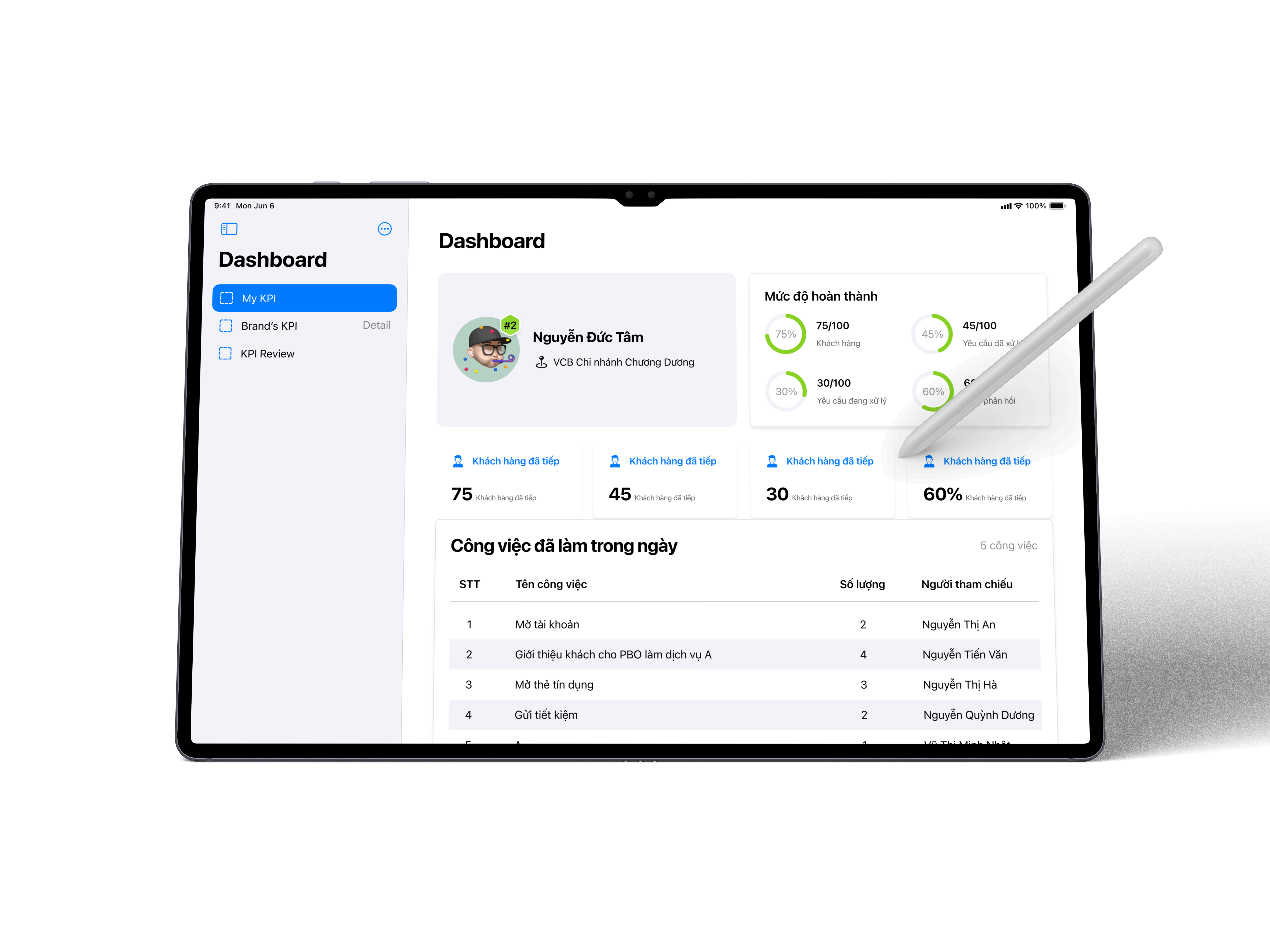
Apple partnered with a leading bank in Vietnam to drive full adoption of its hardware ecosystem. But this wasn’t just about selling devices. It was about delivering value. By embedding tailored software into Apple devices, the goal was to solve real operational pain points — turning each iPhone, iPad, or Mac into something more than just a tool. Into a better way of working.
For this project, I primarily worked as a researcher, where I was in charge of defining the research strategy, creating interview questionnaires, and handling setup and formatting and facilitating design brainstorming sessions.
My main responsibility was to build genuine connections with end users — to help them feel comfortable, see us as friends, and trust us. This helped me understand their needs more deeply — from emotional drivers to day-to-day pain points and actual behaviors.

Through open-ended conversations, we explored what users do, think, and feel. We looked for moments of friction, workarounds, and needs that weren't being met — not just what was said, but what was implied between the lines.
We started not with questions, but with conversation. The goal was to build trust — creating a space where users felt comfortable enough to share openly. This first connection helped surface real stories later on, not just surface-level answers
Watching users in context revealed what words couldn’t. Their routines, tools, and unconscious habits brought hidden pain points to light — the ones they lived with every day but rarely talked about.
Our motto
The more insight we uncover at the start — from user needs to business context — the fewer assumptions we have to make along the way.
Day in a life of (DILO): To uncover deeper user needs beyond interviews, we used the DILO method to map out a typical day of our target users. By documenting their routines, tools, environments, and interactions from morning to evening, we gained a clearer understanding of their pain points in real context.
Synthesize: We gathered hours of interviews and observations, but insight only emerged when everything was laid out, examined, and connected. Patterns started to form — recurring blockers, shared workarounds, and silent frustrations users never said out loud. Through clustering and mapping, we turned noise into clarity, surfacing the core problems worth solving and setting the stage for focused, user-driven design.
Dream: With the pain points laid bare, we imagined a better day — one without blockers, delays, or frustrating workarounds. We re-wrote the user’s journey, turning friction into flow. This wasn’t just solving problems. It was designing a future that felt effortless, intuitive, and real.
To uncover user pain points with both depth and clarity, we chose a blend of qualitative attitudinal and behavioral research methods. Each approach served a distinct purpose in helping us move from assumption to insight.

To explore users' thoughts, expectations, and frustrations in their own words, we conducted in-depth interviews. This qualitative method allowed us to uncover explicit needs and latent concerns that would be difficult to observe directly.
We mapped each question to a research objective. The interview flow was crafted to balance open-ended prompts with targeted follow-ups, enabling us to extract patterns in user motivation, mental models, and friction points in existing workflows.
User interviews helped us identify misalignments between what users expected and what the product delivered . It surfaced emotional pain points—such as confusion, distrust, or hesitation—that guided our prioritization of design fixes.
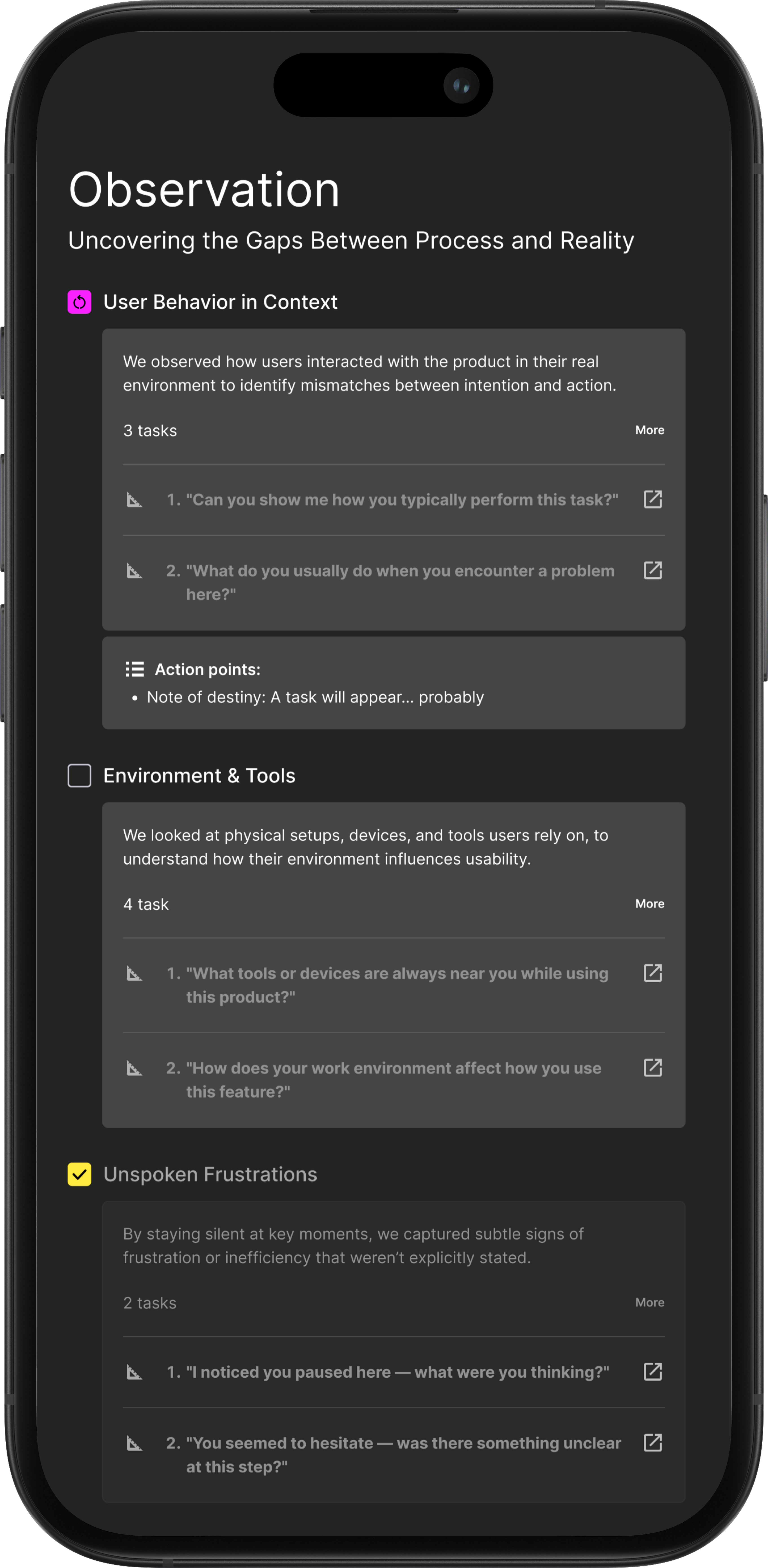
People don’t always articulate their problems — they show them. Observation helped us capture real behavior in real contexts, revealing usability issues and inefficiencies users had normalized over time.
We passively observed users performing key tasks in their natural environments. Instead of asking, we watched: where they hesitated, what they skipped, and how they adapted when the system failed them.
Subtle behaviors—like taking screenshots as reminders or retyping info they had copied—uncovered friction that users couldn’t verbalize. These moments helped us simplify UI flows and reduce cognitive load.

To understand how our product fits into users' broader routines, we needed to zoom out. DILO provided a contextual view of their daily touchpoints, helping us identify when, where, and why our product gets used—or ignored.
We shadowed users through an entire workday, documenting their tasks, priorities, interruptions, and tool switching behavior. This gave us insight into environmental and emotional factors that impact usage.
We discovered that usage doesn’t depend only on UX—it’s shaped by schedules, pressure, and team dynamics. This insight led to features that better fit into users’ real-life workflows, not just ideal scenarios.

While other methods gave us snapshots, the Golden Thread helped us connect dots across users and time. It ensured that insights were not isolated, but part of a coherent, evolving narrative.
We synthesized findings from interviews, observations, and DILOs into storylines that traced a user’s journey from problem to resolution. This framework helped align the team around key insight themes and strategic opportunities.
The Golden Thread revealed consistent pain patterns across personas and touchpoints. It gave us confidence that the problems we chose to solve were not anecdotal—but rooted in shared experience.
I help teams turn complex flows into clear, intuitive interfaces. Available for freelance & short/long-term projects.